- Pain in the ankle
Pain in the ankle
The ankle is the joint that connects the lower leg to the foot. The ankle joint actually consists of two separate joints that produce different movements in the ankle. Pain in the ankle can occur acutely, such as with an ankle sprain, or gradually, for example through overuse.
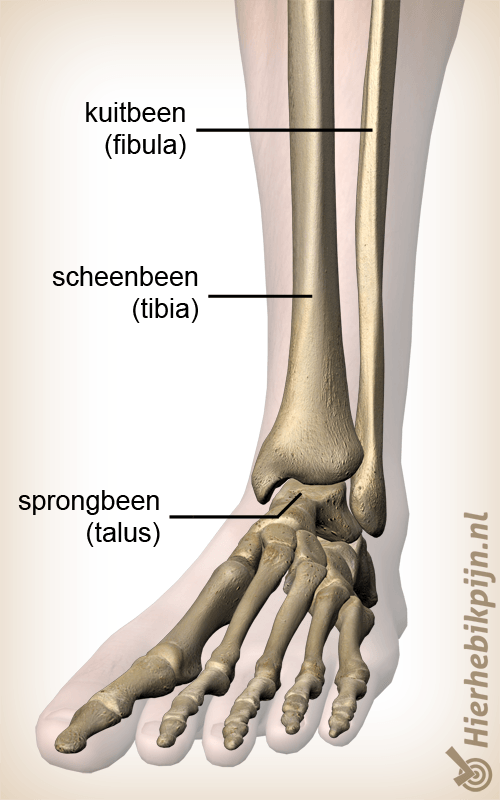
Anatomy of the ankle
In medical terms, the ankle joint is usually referred to as the upper ankle joint. However, in general, the ankle consists of two joints, namely the upper and lower ankle joints.
Upper ankle joint
The upper ankle joint allows the up and down movement of the foot; that is, pulling the toes towards you or pushing them away. It is a so-called hinge joint and connects the shinbone and the fibula with the talus. The bumps on the left and right of the ankle are the ends of the shinbone (on the inside) and the fibula (on the outside).
Lower ankle joint
The lower ankle joint allows the foot to tilt. This means tilting the sole of the foot inwards (inversion) or outwards (eversion). The joint consists of three joint surfaces: from the talus, the heel bone, and a tarsal bone.
Ankle ligaments
The ankle joint is reinforced by ligaments, also called ligaments. Ligaments consist of strong, rigid connective tissue structures that are much less elastic than muscles. These ligaments provide extra stability to a joint. The ligaments of the ankle provide extra stability to the lower ankle joint and are important in preventing sprains. If we twist our ankle with too much force, the ligaments may not be able to absorb the impact. This can cause the ankle ligaments to tear.
Muscles
The muscles around the ankle ensure that it can move in different directions. The calf muscles, together with the Achilles tendon, are mainly responsible for extending the foot (standing on tiptoe). The muscles at the front of the lower leg ensure the foot bends.
Pain? Check your symptoms!
When you have ankle pain, you probably want to know what type of complaint or injury you have. To get a good idea of where the pain in your ankle originates, we advise you to do the online physiotherapy check. You indicate where you have pain and then answer a number of questions about your complaints.
Once you’ve completed the questions, your complaints are compared with the most common ankle conditions in physiotherapy. If necessary, you can visit a physiotherapy practice for professional help.
Conditions
Below you can read more about conditions that can cause ankle pain. Each condition is explained in detail, including the symptoms, causes, and possible treatments. When you complete the online physiotherapy check, your ankle complaints are compared with all these conditions.
Enkel
- Achilles tendinopathy
- Achilles tendon rupture
- Ankle fracture
- Ankle instability
- Anterior ankle impingement
- Bruising
- Fibromyalgia
- Foot drop
- Haglund's exostosis
- Joint mouse
- Lateral ankle ligament injury
- Lymphoedema
- Medial ankle ligament injury
- Osteochondritis dissecans
- Plantar fasciitis
- Posterior ankle impingement
- Rheumatoid arthritis
- Sinus tarsi syndrome
- Tarsal coalition
- Tarsal tunnel syndrome