- Pain in the lower back
Pain in the lower back
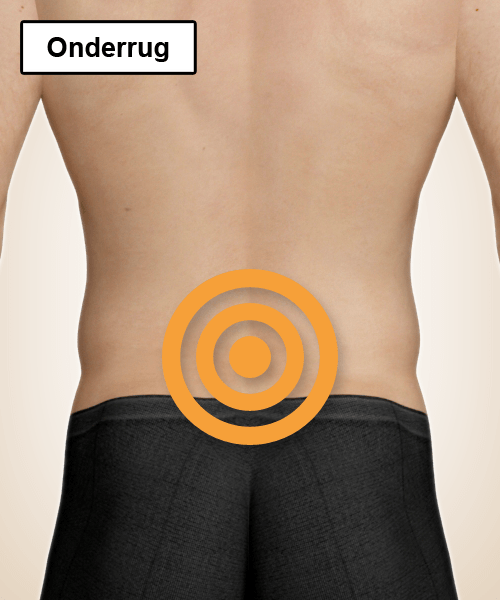
The lower back is the lowest part of the back. Pain in the lower back is usually caused by muscles, but can also be caused by intervertebral discs, vertebrae, joints and ligaments. Low back pain can occur suddenly, for example when one 'pulls their back' or in case of a fracture, but it can also develop gradually due to overuse or poor posture.
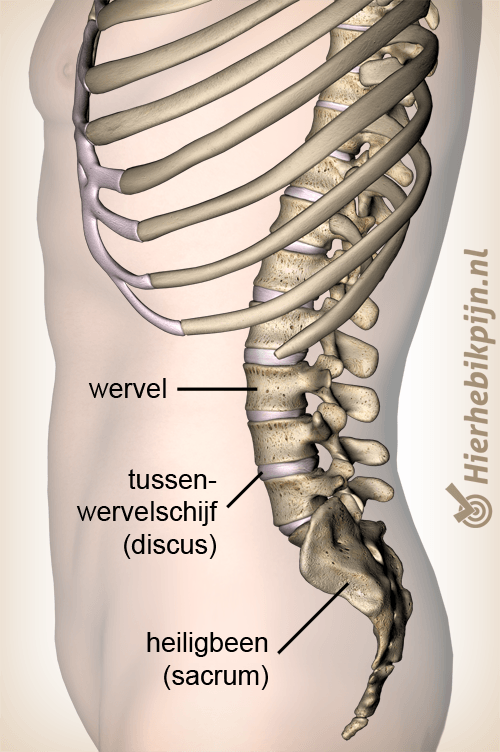
Anatomy of the back
The back is divided vertically into four parts: cervical vertebrae, thoracic vertebrae, lumbar vertebrae and the sacrum. The lower back comprises the five lumbar vertebrae and the sacrum. The sacrum consists of five fused vertebrae, although individual variations exist.
Between the vertebrae are intervertebral discs. These flexible discs provide shock absorption and mobility for the spine. In the lower back, the last intervertebral disc lies between the lowest lumbar vertebra and the sacrum. A vertebra is a bone structure made up of a vertebral arch and two articular processes.
The spinal cord runs throughout the entire spine. The spinal cord consists of nerve cells and nerve pathways. It is well protected by the vertebrae through which it passes. Nerves exit the spinal cord through openings between the vertebrae and extend to all parts of the body.
Pain in the lower back
Low back pain is a very common complaint, often seen between the ages of 35 and 55. Pain in the back often resolves on its own, even without physiotherapy or other treatments.
Low back pain is categorised as with or without neurological symptoms. Neurological symptoms include muscle weakness, tingling, and radiating pain.
Pain without neurological symptoms is primarily caused by posture disorders. Excessive or prolonged strain on the lower back can overwork the back muscles, causing pain in the lower back.
If symptoms have been present for less than six weeks, we refer to an acute back complaint. The term 'acute back complaint' is often misused because people think it only applies when the pain starts suddenly. This is not necessarily the case; it merely indicates the duration of symptoms.
Back problems usually disappear on their own after a short time because the cause is often overstrain. Overstrain may mean that the load has been too great (for instance when lifting a heavy object). However, it may also occur when the load tolerance is too low. This means the back can handle less strain than would normally be expected. Poor physical conditioning of the back and abdominal muscles often lies at the root of this.
What we call a stiff back is in most cases not a problem of the vertebrae, but of the muscles. When it involves the vertebrae, there is an underlying medical diagnosis or abnormality. It is rigid muscles that pull the vertebrae into a stiff position. The function of muscles is to move vertebrae in relation to one another. If one muscle is pulled excessively, it can tilt a vertebra too far to one side.
Pain in the lower back with neurological symptoms is usually caused by a pinched nerve in the back. This can be due to an intervertebral disc pressing on the nerve, problems with the joints or a combination of both. In such cases, the pain extends beyond the lower back, sometimes down to the foot.
Check your symptoms
To get a good first impression of the cause of your back pain, we advise you to take the online physiotherapy check. By indicating where your back pain is located and answering a few questions, your symptoms can be compared with the most common back problems treated in physiotherapy. You can, if necessary, visit a physiotherapist nearby for a professional examination.
Conditions
The following conditions can cause pain in the lower back. Each article is clearly illustrated and provides extensive information about the causes, symptoms and treatment options.
Onderrug
- Bechterew's disease
- Bruised or broken rib
- Bruising
- Dysfunction of the rib joints on the back
- Fibromyalgia
- Lumbar facet syndrome
- Lumbar instability
- Lumbar spinal stenosis
- Lumbosacral radicular syndrome
- Muscle injury of the upper back
- Myositis ossificans
- Nonspecific lower back pain
- Pelvic instability
- SI joint pain
- Scheuermann's disease
- Scoliosis
- Specific lower back pain