
- Anatomy
- Joint capsule
Joint capsule
A joint capsule surrounds the bones of a joint and consists of an inner and an outer layer, both of which are attached to the bones that form the joint.
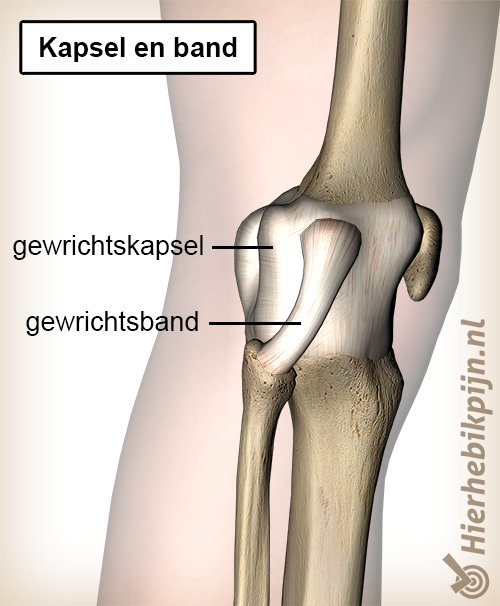
A joint capsule surrounds the bones of a joint and consists of an inner and an outer layer, both of which are attached to the bones that form the joint. We find a joint capsule around the joints of the shoulder, elbow, wrist, ankle, knee, and hip, as well as in the joints of the spine, ribs, and fingers.
The joint capsule is very thin in some places, while in others it is very strong and thick. These thickened areas are called ligaments.
The inner layer of the joint capsule contains many blood vessels, which are important for the production of synovial fluid.
In larger joints, tendons that run over the joint often have extensions into the joint capsule. These extensions prevent the capsule from getting trapped between the joint surfaces. If the entire tendon continues into the joint capsule, as in the shoulder, the tendon plays a significant role in the movements of the joint.
Related topics
- Subscapularis
- Connective tissue
- Joint
- Ligaments
- Joint capsule
- Synovial fluid
- Bursa
- Nervous system
- Central nervous system
- Peripheral nervous system
- Motor nerve
- Sensory nerve
- Muscles
- Tendons
- Proprioception
- Dermatomes
- Hamstrings
- Achilles tendon
- Anatomy of the wrist
- Anatomy of the hand
- Osteoarthritis
- Anatomy of the foot
- Big toe
- Trigger points
- Anatomy of the thigh
- Cartilage
- Rotator cuff
- Intervertebral disc
- SI joint
- Lungs
- Anatomy of the abdominal muscles
- Anatomy of the bones
- Pelvic floor muscles
- Trapezius muscle
- Skin
- Anatomy of the spine