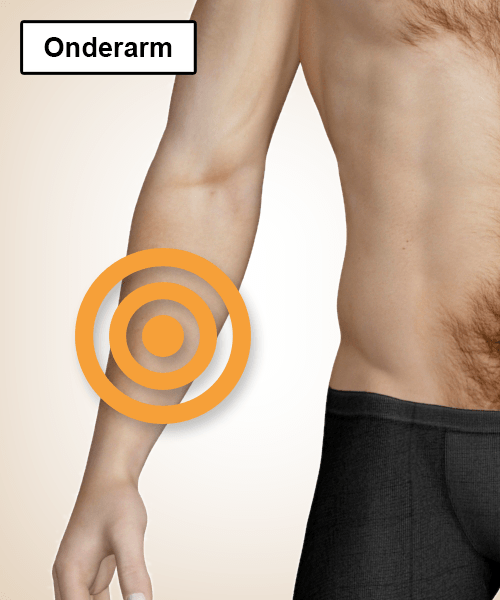
- Forearm pain
Forearm pain
The forearm is the part between the elbow joint and the wrist joint. The forearm contains many muscles that are important for hand function. Pain in the forearm can therefore be very troublesome when performing daily activities in which we need our hands.
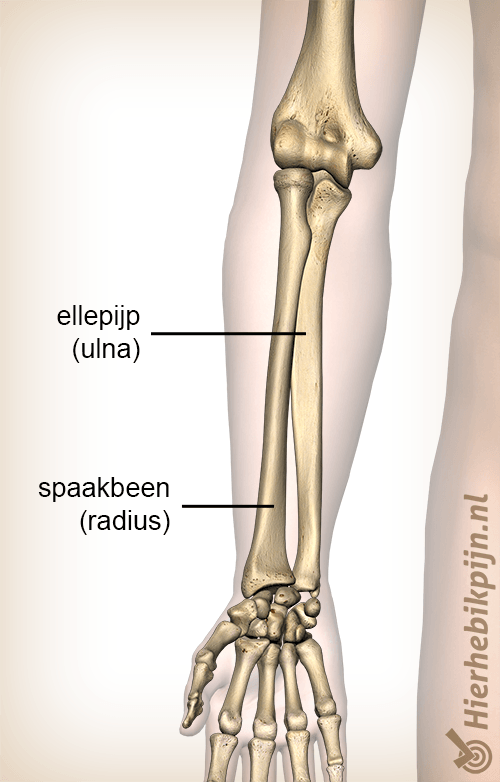
Anatomy of the forearm
The forearm consists of two bones; the ulna and the radius. Thanks to these two bones it is possible to rotate the forearm without the elbow or wrist joint moving. There are 19 muscles in the forearm. These muscles can be divided into three groups:
- Muscles that only move the forearm.
- Muscles that attach to the metacarpals and therefore move the hand.
- Muscles that attach to the finger bones and are therefore partly responsible for movement of the fingers.
Different blood vessels and nerves run through the forearm. The blood vessels aim to supply the forearm and hand with nutrients, and to remove waste products. The nerves ensure that we can control movements and perceive pain.
Pain symptoms
Pain in the forearm can arise both acutely and gradually.
Acute forearm pain
Pain that arises acutely is often the result of an accident or fall. Different structures in the forearm can be damaged. Muscle tears, contusions and bone fractures are regularly seen in acute forearm pain.
Non-acute forearm pain
Symptoms that have no clear cause and have increased over a longer period usually arise due to overuse. The muscles in the forearm are important for hand, wrist and elbow function. If these muscles are overloaded by heavy or prolonged activities, pain symptoms arise. The tendons of the muscles are particularly sensitive to this because they are less well supplied with blood and recover more slowly after heavy overuse.
Commonly seen
The best-known condition of the forearm is the so-called tennis elbow (also called lateral epicondylitis). Here the attachment of different forearm muscles on the outside of the elbow is affected. The resulting pain can radiate over the full length of the forearm. If the pain is on the inside of the elbow/forearm, this is often called a golfer's elbow (or medial epicondylitis).
The muscles in the forearm, like those in the lower leg, lie in different compartments. Here a group of muscles is surrounded by a fascial sheath. If overuse causes too high a tension in a compartment, this can cause significant symptoms in the forearm region.
In addition to symptoms of muscles, tendons and bones, nerves can also cause pain in the forearm. The cause is then often in the elbow where the nerve can become trapped. As a result, radiating pain is felt in the forearm.
Check your forearm symptoms
Do you currently have pain in the forearm and are you curious what is going on? Then you can investigate yourself by doing the online physiotherapy check. Indicate where you feel the pain in your forearm and then answer a number of questions about your symptoms. You will then immediately receive an overview of forearm complaints you might be suffering from. It is advisable to have a physiotherapist look at your forearm.
In our overview of physiotherapists you can easily find a physiotherapy practice nearby that can help you further.
Conditions
The conditions below can cause pain in the forearm. Click on the name of a condition for more information.