- Upper back pain
Upper back pain
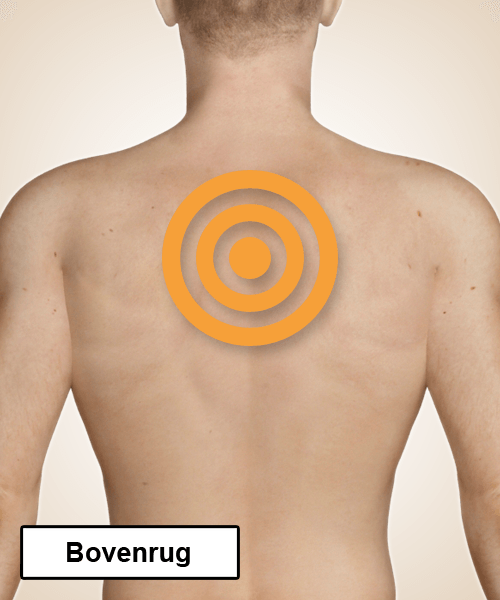
Pain in the upper back is felt in the area from the neck down to the lower back. Or more simply: the area between or below the shoulder blades. Pain in the upper part of the back can influence other body parts, which in turn can also start to cause symptoms.
Anatomy of the upper back
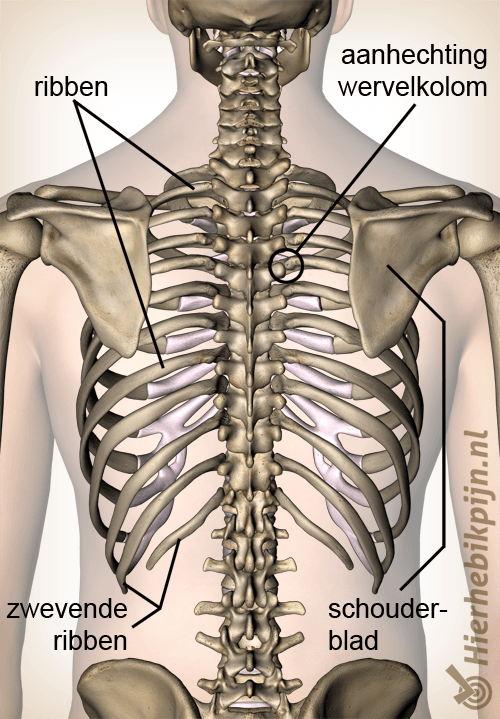
The upper back consists of 12 vertebrae and 12 pairs of ribs. These ribs are attached to the vertebrae of the upper back. Because of the ribs, the upper back is much less mobile than the neck and lower back.
The vertebrae of the upper back together form the thoracic spine. The muscles of the thoracic spine are supplied from the neck. The nerves that exit in the upper back supply the organs in the chest.
The ribs, the position of the spine, the muscles and the organs can all play a role in pain symptoms in the upper back. Normally everything works neatly together, but if there is a problem somewhere, other parts can also become disturbed.
The ribs should spread a little with each inhalation and come together again with each exhalation. In this way, many small joints are activated just through breathing. The spreading of the ribs ensures that the lungs can become larger with each inhalation.
The shoulder blades glide over the upper back. However, because the shoulder blade is part of the shoulder, this does not belong to the upper back but to the shoulder. This shows how much influence everything has on each other.
Pain symptoms
With a painful upper back, heart problems must first be ruled out, as this can cause pain between the shoulder blades combined with chest pain. Heart problems are often provoked by exertion.
Pain between the shoulder blades more often indicates a problem with the ribs, the vertebrae, the breathing or pain that originates from the muscles that are controlled from the neck.
If ribs or vertebrae do not have the proper mobility, you can get upper back symptoms because movement has to take place in a forced way. The physiotherapist can help improve mobility in this case.
In addition, posture is of great importance for the upper back. The rounding of the upper back has a direct influence on the neck, and the neck supplies the muscles of the upper back.
The position of the upper back also determines how the shoulder blades are positioned, which in turn form the base of the shoulder and the arm. A poor posture can therefore cause pain in the upper back, but also pain towards the shoulders.
Acute pain can be caused by trauma (accident or fall), in which a rib is bruised or broken. A broken or bruised rib often causes very unpleasant pain when (deep) breathing or coughing.
What is causing your upper back symptoms?
Do you have pain in the upper back and want to know what is going on? Then it is wise to have a physiotherapist examine your upper back. In our overview of physiotherapists you will find a physiotherapy practice that can help you further.
Do you want to investigate first yourself? Then you can get a first indication of your symptoms by doing the online physiotherapy check. Indicate where you feel the pain in your back and answer the questions. You will then immediately receive an overview of back complaints you might be suffering from.
Upper back conditions
The overview below shows the most important conditions that can cause pain in the upper back. Click on the name of a condition to read more about the cause, symptoms, treatment and underlying anatomy.
Bovenrug
- Acute torticollis
- Bechterew's disease
- Bruised or broken rib
- Bruising
- CANS (complaints of arm, neck and/or shoulder)
- Cervical facet syndrome
- Cervical posture syndrome
- Cervical radiculopathy
- Costochondritis
- Dysfunction of the rib joints on the back
- Fibromyalgia
- Muscle injury of the upper back
- Scheuermann's disease
- Scoliosis
- Whiplash associated disorders