- Pain in the shoulder
Pain in the shoulder
Various structures in and around the shoulder work together to allow the shoulder to move properly. Unfortunately, this doesn’t always work as it should. Shoulder pain can occur suddenly or develop gradually over a longer period. This often presents itself as pain or limited movement.
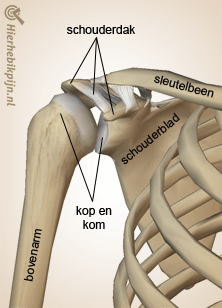
Anatomy of the shoulder
The bones located in the shoulder are the shoulder blade (scapula), the upper arm bone (humerus), and the collarbone (clavicle). The shoulder blade contains a socket in which the head of the upper arm moves. Together, the upper arm and the shoulder blade form the 'glenohumeral' joint. Above this joint lies the shoulder roof. The shoulder roof consists of bone parts of the shoulder blade and several ligament-like bands (ligaments).
On top of part of the shoulder roof, called the 'acromion', the collarbone attaches. It runs from the shoulder forward to the breastbone, just below the neck. Both the shoulder blade and the collarbone move when we lift the arm fully upwards.
Around the above-mentioned bones are many structures such as muscles, capsules, ligaments, bursae, blood vessels and nerves that work together to allow the shoulder to function as well as possible. A problem with one or more of these structures can lead to shoulder complaints.
Check your shoulder complaints
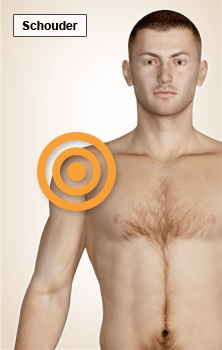
To get a good idea of the cause of pain in the shoulder, we advise you to take the online physiotherapy check. By pointing to the area where you feel pain and then answering the questions, your shoulder complaints are compared with the most common conditions in physiotherapy.
Shoulder conditions
Below is an overview of conditions that can cause pain in the shoulder. Each article provides detailed information about the complaints, their cause and possible treatments. When you do the online physiotherapy check, your complaints are compared with all these conditions.
Schouder
- Acromioclavicular injury
- Broken collarbone
- Bruised or broken rib
- Bruising
- CANS (complaints of arm, neck and/or shoulder)
- Cervical posture syndrome
- Costochondritis
- Fibromyalgia
- Frozen shoulder
- Heart disease
- Impingement syndrome
- Internal impingement
- Joint mouse
- Myositis ossificans
- Osteoarthrosis of the shoulder
- Osteochondritis dissecans
- Proximal biceps injury
- Pulmonary embolism
- Rheumatoid arthritis
- Rotator cuff injury
- SLAP lesion
- Shoulder instability
- Shoulder subluxation
- Subscapularis tendinopathy
- Thoracic outlet syndrome
- Tietze's syndrome