
- Physical complaints
- Tendinopathy
Tendinopathy
The term tendinopathy is composed of the Greek words tendon and –pathy (which indicates disease, condition or disorder). Freely translated, tendinopathy is therefore a tendon disorder. There are many different tendon disorders, but they all fall under the concept of tendinopathy.
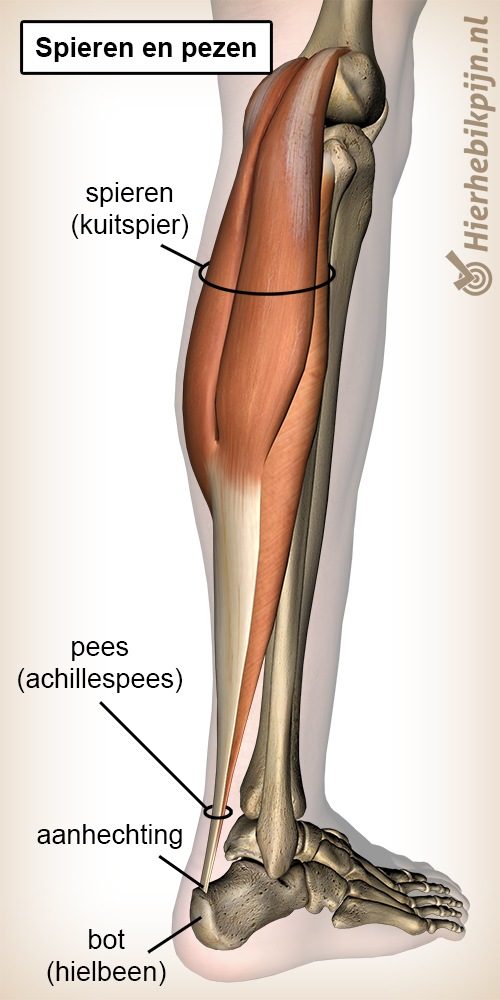
The main tendon disorders are:
- Tendinitis (-itis stands for inflammation).
- Tendinosis (-osis stands for reduced quality of the tendon).
- Tendon rupture (-rupture stands for partial or complete tear of the tendon).
Where can a tendinopathy occur?
Tendons are found throughout the body and form the connection between muscles and bones. In principle, a tendinopathy can occur in any tendon. Nevertheless, there are a number of locations that are clearly more often involved in tendon disorders. Think in particular of:
- Shoulders — A good example is tendon disorders of the rotator cuff muscles (shoulder stabilisers).
- Elbows — In the region around the elbow, a tennis elbow and a golfer's elbow are common tendon disorders.
- Knees — A jumper's knee and a runner's knee are common tendon disorders of the knee.
- Lower leg — The most well-known in this region is an injury to the Achilles tendon.
How does a tendinopathy arise?
In general, a tendinopathy is directly related to physical loading. Especially in the case of tendinitis or rupture, there is almost always overloading or underloading of the tendon. Long-term underloading leads to weakening of the tendon and makes it more vulnerable to injuries.
There are also several risk factors for tendon disorders. We distinguish intrinsic factors (factors specific to the person) and extrinsic factors.
Examples of intrinsic risk factors are: age, sex, overweight, abnormalities in the position of the foot/feet.
Extrinsic factors that can influence tendon disorders include: weather conditions, the type of surface, type of footwear, and the degree of training build-up.
How is a tendinopathy treated?
In principle, for all tendon disorders, adjustment of activities and strengthening of the tendon are the most important parts of treatment. To reduce the risk of a tendinopathy, it is very valuable to address the risk factors mentioned.
Frequently used treatment options for a tendinopathy include shockwave therapy, percutaneous electrolysis, and taping. In all these forms of treatment, pain reduction is the first treatment goal. This is followed by exercise therapy to strengthen the muscles and tendons again.
Contact a physiotherapist to help you get rid of your tendon complaints.
Related topics
- Muscle soreness
- Muscle cramp
- Muscle contusion
- Muscle strain
- Inflammation
- Heel spur
- Sprained ankle
- Cervical herniated disc
- Herniated disc
- Sciatica
- Polymyalgia rheumatica
- Bursitis
- Lumbago
- Groin pain
- Hypermobility
- Hip dysplasia
- Spondylosis
- Overuse
- Referred pain
- Worn hip
- COPD
- Tendon inflammation
- High blood pressure
- Tendinopathy
- Torn ankle ligament
- Bronchitis
- Emphysema
- Lower back pain
- Asthma
- Knee osteoarthritis
- Floating rib syndrome
- Scapula alata
- Cracking joints
- Back pain
- Discopathy
- Incontinence
- Pneumonia
- Fracture
- Flat feet
- High-arched feet
- Types of bone fractures
- Bone fracture
- Pigeon chest
- Funnel chest
- Fluid in the ankle
- Fluid in the knee
- Sarcopenia
- Iliotibial band friction syndrome
- Impingement syndrome
- Tremor
- page_id_642_title