
- Physical complaints
- Bone fracture
- Broken tailbone
Broken tailbone
The tailbone or coccyx, in Latin coccyx, is the end of the spine. It is unknown what the precise function of this piece of bone still is, but it is a remnant of what was once a tail.
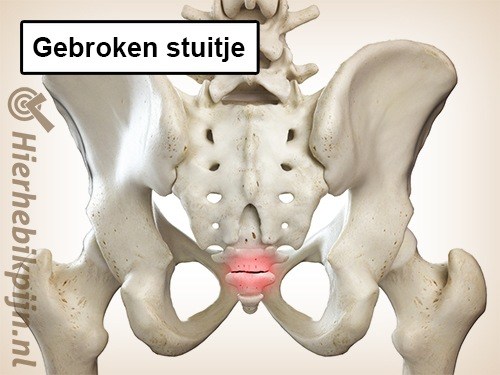
How does a broken tailbone occur?
In most cases there is a clear moment when the tailbone breaks. A fall flat on the buttocks on a hard surface, such as slipping while skating, from the stairs or on the street. A hard collision or kick, directly on the tailbone, can also lead to a break of the tailbone.
Another possible cause of a broken tailbone takes place during childbirth in women. Due to the pressure of pushing and giving birth the tailbone can bend and in some cases break. In people with osteoporosis (bone demineralisation) the tailbone can break because the bone is more brittle (weaker). In this case even a soft blow or fall may be enough for a break.
Characteristics of a broken tailbone
The complaints with a broken tailbone differ per patient. The pain can be experienced as a slight ache, but there can also be severe pangs of pain. This pain can even radiate towards the buttocks, groin and into the legs. Depending on the pain, one person cannot even sit on the buttocks while another can continue to ride a horse or cycle.
In more severe breaks there can also be complications. By complications is meant that the break also causes other (severe) complaints. Examples of this are problems when urinating or defecating or an entrapment of the nerves that run right next to it. These nerves cause paralysis and sensory disturbances in a leg when pinched. These are reasons to seek medical help immediately.
How is a broken tailbone diagnosed?
The patient history is very important to find out the precise injury. Even a hard fall or collision in the past is important information. It is possible that the tailbone was then broken or bruised and is now causing complaints again. To further investigate the possible break, an X-ray will be taken, two to be precise. One from the front and one from the side.
If in doubt, a CT scan will also be taken. After these examinations it can almost be determined with certainty whether there is a broken tailbone. An MRI scan is also among the possibilities. This provides even more information about the ligaments, muscles and nerves near the tailbone.
Treatment of a broken tailbone
If the tailbone is actually broken, it is for the treatment options mainly important whether complications have occurred. If this is not the case, it is usually decided to let the break heal with bed rest. The break then usually heals by itself.
If the break does not or insufficiently heals, or in the case of complications, surgery may be considered. One of the treatment options is then the removal of the tailbone. A lot of research is being done into the results of this operation. So far the outcomes have been very variable.
Even without surgery there are ways to reduce the complaints. What works best varies from person to person. In any case, it is recommended to consult a pelvic physiotherapist if you have complaints around the tailbone. In some cases a special cushion with a hole in it (donut cushion or ring cushion) relieves the pain complaints.
A lack of magnesium increases the risk of bone fractures. In some cases food supplements such as calcium and magnesium also seem to have a positive effect on recovery. Always make sure that the treating doctor is aware of the use of supplements.
Related topics