
- Physical complaints
- Bone fracture
- Broken vertebra
Broken vertebra
With a broken spinal vertebra or vertebral fracture there is a break in the vertebral body. Vertebral fractures are divided into two groups, stable and unstable fractures. In a stable fracture there is only a break in the vertebral body and the spinal cord is not at risk. This is different with an unstable break. Because various bone fragments do not remain firmly in place, there is a chance that the spinal cord will be damaged.
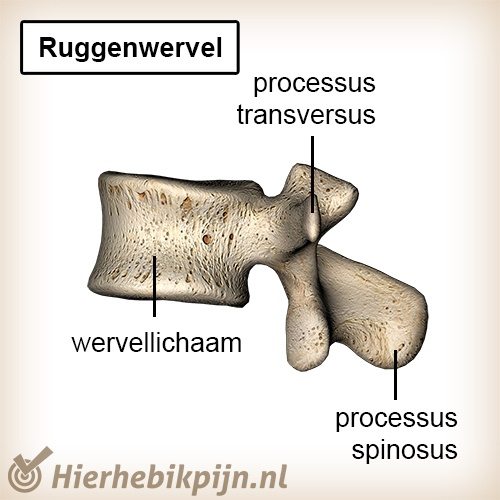
The spine is built from top to bottom from seven cervical vertebrae, twelve thoracic vertebrae and five lumbar vertebrae, followed by the tailbone. The structure of the vertebrae differs per region of the spine. But they all have a vertebral body, a vertebral arch and a spinous process. An exception to this are the first two cervical vertebrae and the tailbone, which have a completely different shape.
The vertebral arches form an opening through which the spinal cord runs. The spinal cord provides a connection between the brain and the outgoing nerves. These nerves extend into the fingers and toes and run outside the spine through so-called foramina, openings between the vertebral bodies.
How does a broken vertebra occur?
With a broken vertebra two different causes are distinguished: traumatic and non-traumatic. Traumatic is a break due to an accident such as a car accident, a fall from height or a blow to the spine. In a non-traumatic break there is no clear moment when the break occurred. This is also called a pathological fracture. In a pathological fracture an underlying disease such as bone demineralisation (osteoporosis) or bone cancer causes the bone quality to deteriorate and a vertebra to break more easily.
Characteristics of a broken vertebra
A stable vertebral fracture, i.e. without displacement of bone fragments, is not always accompanied by severe complaints. However, making movements with the spine is often limited and can be accompanied by a dull pain.
In an unstable vertebral fracture the complaints are more serious. If the spinal cord is damaged, complaints such as paralysis and sensory disturbances can occur. In more severe cases, depending on the location of the break and the degree of spinal cord injury, a spinal cord injury can occur. In this case the nerve tracts in the spinal cord at the level of the break are irreparably damaged.
How is a broken vertebra diagnosed?
The patient history, in combination with a physical examination, can alert the GP or physiotherapist that it is probably a vertebral fracture. The break must always be confirmed by examination in hospital. During this examination a X-ray or CT scan can determine whether the break is stable. This is important for choosing the right treatment. With an MRI scan the damage to the spinal cord and the nerves can be visualised in detail.
Treatment of a broken vertebra
The treatment of a vertebral fracture depends for the most part on the type of break and possible damage to the spinal cord and the nerves. A stable break is often treated with bed rest. Possibly in combination with wearing a supportive corset while sitting, standing and walking.
In an unstable break it is usually decided to repair the break with an operation. This choice is made to reduce or prevent damage to the spinal cord and nerves immediately. A period of enforced bed rest then follows. The spine may only be moved again when the break has sufficiently healed.
During the period of rest the physiotherapist can already be of value by giving tips and advice. Think of learning an appropriate lying or sitting position within the pain limits. But also of certain rules of daily living in order to be as independent as possible in these first weeks.
After this period of rest the back must be made stronger and more mobile again. Here too, guidance by a physiotherapist is absolutely recommended. Find a physiotherapist near you who will guide you in this.
Related topics