
- Physical complaints
- Tendon inflammation
- Knee tendon inflammation
Knee tendon inflammation
A tendon inflammation is the result of damage to the protective layer of a tendon. This damage causes the tendon to become inflamed. It feels warm, is painful and swells. This makes moving the knee more difficult.
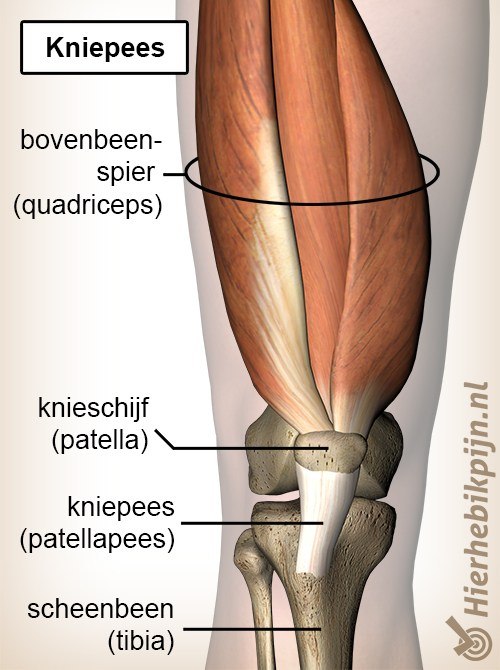
The knee has several muscles that attach to the knee joint via tendons. These tendons play an important role in stabilising the knee and in enabling movement.
Cause of tendon inflammation in the knee
A tendon inflammation in the knee generally arises due to (prolonged) overuse. Especially through sports such as football, athletics, volleyball and basketball. Other risk factors include an abnormal position of one or both legs, an incorrect (running) technique or being overweight.
The tendon in the knee that most often becomes inflamed is the patellar tendon (kneecap tendon). This tendon is an extension of the thigh muscles and attaches from the kneecap (patella) to the shin bone. An inflammation of this tendon is also referred to as jumper's knee (springer's knee).
Symptoms of tendon inflammation in the knee
All tendon inflammations in the knee show a similar pattern. The tendon inflammation can be recognised by (pressure) pain at the level of the tendon. The tendon can feel warm and look swollen. There may also be pain during movements or stiffness of the tendon at the start of activities.
The course of a tendon inflammation in the knee is characterised by three successive phases. In the first weeks of the tendon inflammation, the pain is limited to after exertion. In the next phase the complaints are also present during sport. After a good warm-up the complaints diminish. In the last phase the complaints are chronic; the pain will be present regardless of the sporting load.
It is therefore very important to take rest in time in the first two phases to prevent the complaints from becoming chronic.
Diagnosis of tendon inflammation in the knee
In general, a physical examination by the GP or physiotherapist will suffice. They have a number of specific tests at their disposal.
In case of doubt, the GP may choose to perform additional tests. An ultrasound scan or MRI scan will most likely provide sufficient clarity.
Treatment of tendon inflammation in the knee
For good treatment of a tendon inflammation in the knee it is extremely important to recognise the complaints in time. In the early phase of the complaints, taking sufficient rest and cooling may be sufficient to reduce the complaints within a few weeks.
If the complaints increase, it is advisable to consult a physiotherapist. In a tendon inflammation in the knee, treatment will first focus on pain reduction. Common treatment options for this are frictions, taping and shockwave. Depending on the severity of the complaints, recovery will take approximately six to twelve weeks.
Following this, the most important goal is to increase load capacity. Research has shown that exercise therapy is very effective in this regard. In recurrent tendon inflammations, a brace or patellar strap may be considered to better support the knee.
Related topics