
- Anatomy
- Trigger points
Trigger points
Trigger points or muscle knots are hard, palpable thickenings in a muscle. At the site of a trigger point, a hypersensitive spot with radiating pain can develop.
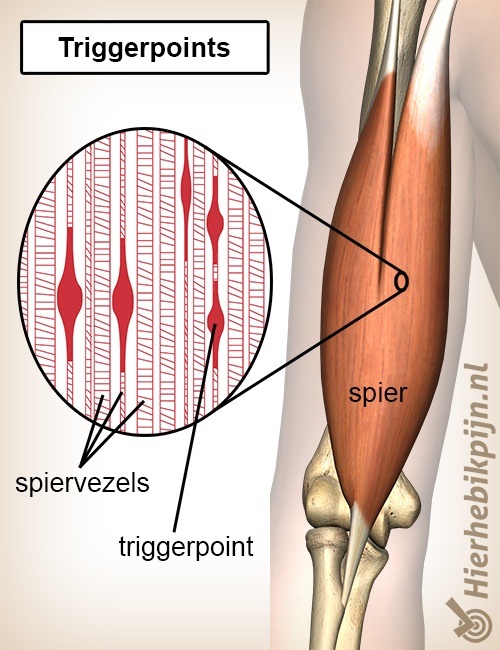
Trigger points arise in small parts of the muscle. They are very local cramps affecting a few muscle fibres. As with calf cramp, where an entire muscle goes into spasm, this can occur very locally.
A trigger point can be spontaneously painful. The trigger point is then active. When there is only pain when pressing on the muscle knot itself, it is called a latent trigger point.
Trigger points are common in the so-called myofascial pain syndrome. This syndrome describes pain that is located in the muscles (myo) and in the connecting structures (fascia). These are therefore myofascial trigger points.
Myofascial pain is a clinical diagnosis. This means that the diagnosis is made based on complaints and symptoms. It is not a diagnosis that can be confirmed by laboratory research.
Symptoms of trigger points
Trigger points can cause a painful and/or stiff feeling in the muscle itself or radiate to another location in the body. Sometimes there is a limitation of movement and loss of strength.
Because trigger points also affect the connecting structures around muscles, the pain area can be quite large. There may even be referred pain. This means that the cause of the pain is in a different place than where the pain is actually felt.
Origin of trigger points
Much is still unclear about the cause and origin of trigger points. Currently, it is thought that trigger points arise as a result of a lack of blood flow and oxygen in muscles.
Normally, muscles lengthen and shorten with movement. At rest, the muscle fibres are completely relaxed. When a muscle does not receive sufficient blood flow, oxygen, and nutrients, muscle fibres can cramp. The muscle fibres are then continuously contracted and no longer relax properly. The local cramp of muscle fibres is called a trigger point.
Possible causes of trigger points are:
- Maintaining the same posture for a long time.
- Stress.
- Overuse.
- Acute trauma (accident or fall).
Trigger points are a consequence. Trigger points themselves are never the cause. This means that trigger points can be treated, but when the underlying cause is not addressed, the complaints will probably return.
Trigger points are also always fixed points in the body. Each trigger point has its own referral area. This is the area where the complaints are felt. For example, trigger points in the lower back cause radiation into the hip and buttock region.
Treatment of trigger points
Trigger points can be treated in different ways:
- Pressure point massage.
- Dry needling.
- Manual therapy.
- Mobilisation.
- Exercise therapy.
- Posture and movement advice.
Pressure point massage, dry needling, manual therapy, or mobilisation are ways to treat the trigger point directly. Exercise therapy and posture and movement advice are intended to maintain the effects of the above treatments. With exercise therapy, you stimulate blood flow and strengthen the muscle, so that trigger points are less likely to become active.
Quickly and easily make an appointment with a physiotherapist.
Related topics
- Subscapularis
- Connective tissue
- Joint
- Ligaments
- Joint capsule
- Synovial fluid
- Bursa
- Nervous system
- Central nervous system
- Peripheral nervous system
- Motor nerve
- Sensory nerve
- Muscles
- Tendons
- Proprioception
- Dermatomes
- Hamstrings
- Achilles tendon
- Anatomy of the wrist
- Anatomy of the hand
- Osteoarthritis
- Anatomy of the foot
- Big toe
- Trigger points
- Anatomy of the thigh
- Cartilage
- Rotator cuff
- Intervertebral disc
- SI joint
- Lungs
- Anatomy of the abdominal muscles
- Anatomy of the bones
- Pelvic floor muscles
- Trapezius muscle
- Skin
- Anatomy of the spine