
- Physical complaints
- Bone fracture
- Broken fibula
Broken fibula
A broken fibula is a fracture of the lower leg. The lower leg consists of the shinbone and the fibula.
A fracture of the fibula is in most cases at the lower end, so at the ankle. A fracture in this part of the fibula is classified according to the 'Weber classification'. A fracture at the upper end of the fibula is much less common.
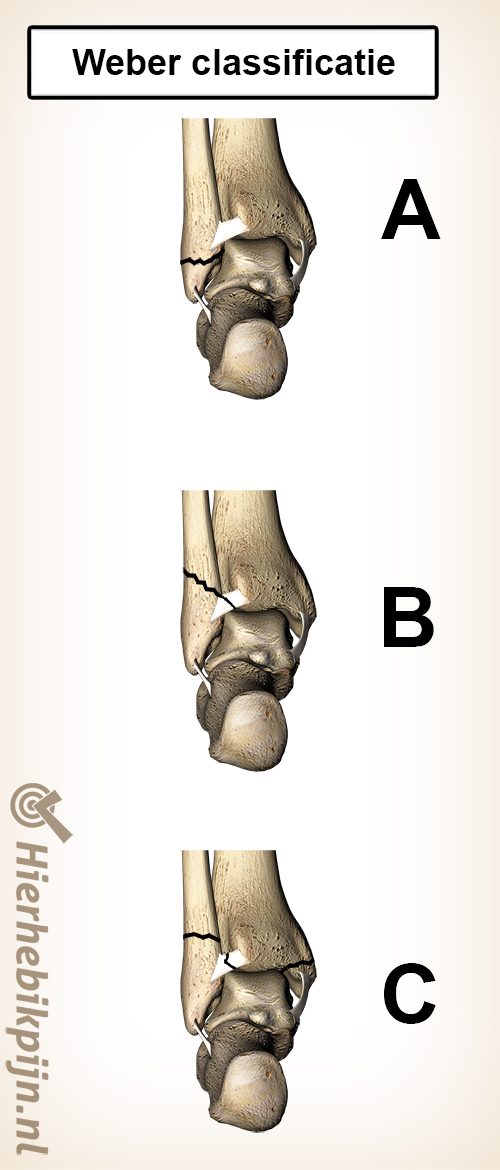
Weber classification for fibula fractures
Dr Bernhard Georg Weber, a Swiss surgeon, was the first to classify fibula fractures based on the location of the fracture. The classification is used to determine which treatment is needed to allow the fracture to heal. In this classification the syndesmosis plays an important role.
The syndesmosis is the joint with ligaments between the fibula and the tibia, just above the ankle. With a fracture of the fibula there is a risk of damage to the syndesmosis. If this joint is damaged, the fibula and tibia can come too far apart. The result is an unstable ankle mortise. Unstable means in this case that there is an increased risk of osteoarthritis of the ankle joint or persistent ankle pain.
The Weber classification consists of three types of fractures:
| Weber | Meaning |
|---|---|
| A | The fibula is broken below the syndesmosis and there is no additional damage to other bone fragments or ligaments of the ankle. |
| B | The fracture is at the level of the syndesmosis. This increases the chance of damage to the syndesmosis and ankle ligaments. |
| C | The fracture is above the syndesmosis and it is usually damaged. This is the most troublesome fracture of the three. This type of fracture often goes together with damage to the ankle ligaments and a fracture or dislocation of the lower end of the tibia. |
How does a fracture of the fibula occur?
A fibula fracture arises in most cases due to a trauma (accident). For example due to a side impact on the bone during a collision or in contact sports such as football and hockey. There is then a high-energy trauma; the blow to the bone is so hard that it breaks.
This is not the case with a Weber A fracture. For this type of fracture a high-energy trauma is not always necessary. There may also be an avulsion fracture. Here the very end fragment of the fibula is pulled off by an ankle ligament. This usually happens when the ankle is sprained.
Another possible cause of a fracture of the fibula is osteoporosis. This makes the bone fragment more likely to break.
Characteristics (symptoms) of a broken fibula
Almost immediately after the fracture it is no longer possible to bear weight on this leg. There is severe (pressure) pain and the lower leg may be crooked. This is usually not visible with a Weber A fracture, but can be the case with a Weber B or C fracture.
With a fracture at the bottom of the fibula there is pain with movements of the ankle, it swells and turns blue. This is different with a fracture at the top of the fibula. Here movements of the ankle are usually not painful and the fracture is not always visible. If there is any swelling and discolouration, this is usually on the outside of the lower leg, just below the knee.
How is a broken fibula diagnosed?
The patient's account, followed by physical examination, often provides sufficient clues. To further investigate a possible fracture, specific questions are asked and tasks are given. This is according to the so-called 'Ottawa Ankle Rules'. These rules help to distinguish between a broken fibula and an ankle sprain.
If a broken fibula is suspected, imaging is always performed. Usually these are first X-rays from the front, side and oblique. These images provide information about the type of fracture. With a Weber B and especially with a Weber C fracture, a CT scan or MRI scan may also be made. This shows better whether there is damage to the syndesmosis. It also provides more information about possible injury to ankle ligaments, muscles or surrounding nerves.
Treatment of a broken fibula
Many medical specialists use the Weber classification to determine whether an operation is necessary. With a Weber A fracture this is usually not the case and the broken bone fragment is treated with a rest period of about 6 weeks. During this period you are not allowed to bear weight on the leg. Non-weight-bearing ankle movements within the pain limit are allowed. Sometimes the lower leg is put in plaster for protection.
With a Weber B, but especially with a Weber C fracture, there is a smaller chance of natural healing. This is called an unstable fracture. An operation is then necessary. The broken bone fragment and the syndesmosis are then repaired during surgery with fixation material. This fixation material consists of plates, screws, wires and/or pins.
During rehabilitation, guidance by a physiotherapist is certainly recommended. It is important to build up mobility, muscle strength and load-bearing capacity again. The physiotherapist uses treatments such as mobilisation techniques, massage, medical taping and exercise therapy.
Related topics