
- Anatomy
- Subscapularis
Subscapularis
The musculus subscapularis is a muscle that belongs to the rotator cuff of the shoulder. It originates on the front of the shoulder blade (fossa subscapularis) and inserts on the lesser tubercle of the humeral head (tuberculum minus).
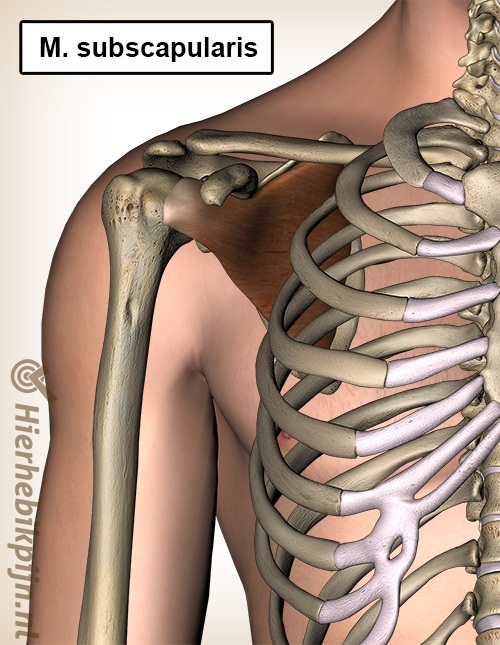
The subscapularis muscle provides compression in the shoulder joint and thus keeps the humeral head in the socket. In addition, it enables inward rotation of the shoulder and provides stability at the front/underside of the shoulder joint.
The nerve that controls the m. subscapularis originates from the neck between the vertebrae C5–C8, i.e., between the 5th and 8th cervical vertebrae. The nerve that arises from this is the subscapular nerve.
Related topics
- Subscapularis
- Connective tissue
- Joint
- Ligaments
- Joint capsule
- Synovial fluid
- Bursa
- Nervous system
- Central nervous system
- Peripheral nervous system
- Motor nerve
- Sensory nerve
- Muscles
- Tendons
- Proprioception
- Dermatomes
- Hamstrings
- Achilles tendon
- Anatomy of the wrist
- Anatomy of the hand
- Osteoarthritis
- Anatomy of the foot
- Big toe
- Trigger points
- Anatomy of the thigh
- Cartilage
- Rotator cuff
- Intervertebral disc
- SI joint
- Lungs
- Anatomy of the abdominal muscles
- Anatomy of the bones
- Pelvic floor muscles
- Trapezius muscle
- Skin
- Anatomy of the spine