
- Football
- Warming-up
- Stretching
Stretching
Most footballers stretch their muscles, often out of habit or because the trainer said it is good for you. But why should you stretch and how can footballers best stretch? We will explain it here for you.
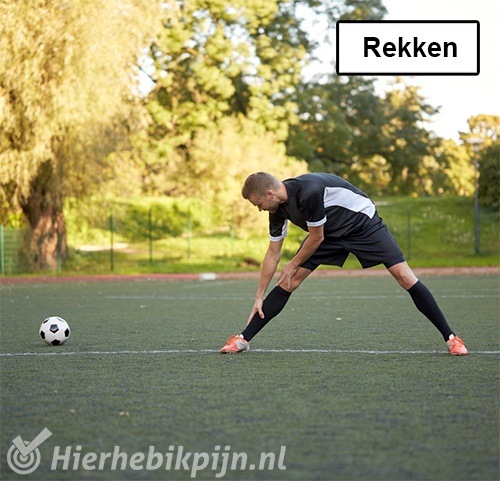
The purpose of stretching
The purpose of stretching is to improve the mobility of a joint so that movements run more smoothly. Regular and consistent stretching leads to a reduced risk of injuries.
Stretching exercises only make sense if they are performed in combination with a good warm-up. If you only do stretches, then that has little added value. If you do both stretches and a warm-up, this can prevent injuries and improve performance.
Stretching does not only have advantages. Depending on how you stretch, it can also cause a direct loss of strength and endurance of the stretched muscle. Stretching can therefore also reduce performance, which increases the risk of injuries again. When a footballer wants to stretch extensively to prevent injuries, it is therefore advisable to do the right stretches at the right time.
When to stretch?
You can stretch at different times: during the warm-up, during the cooling down, or outside of matches/trainings. Below, we discuss different stretching techniques. Each technique has a different ideal moment at which you should best do the stretches. We will tell you when to do the exercises for each technique.
Different types of stretching exercises
There are four different types of stretching exercises that all have a different purpose:
- Dynamic stretching.
- Static stretching.
- PNF stretching (Proprioceptive Neuromuscular Facilitation).
- Ballistic stretching.
Stretching before the match/training
| Dynamic stretching |
|---|
| Before the training/match |
Dynamic stretching is performed during sport-specific movements over the entire length of the muscle. For football, the "leg swing" is a good example of dynamic stretching. These exercises are often performed during the warm-up and are not described as stretching exercises. The goal is to increase mobility without loss of muscle tone.
The exercise should be performed in sets of 8 to 12 repetitions. Start with small movements and increase the movement during the repetitions. The exercise should not be painful, and the range of movement should not be forced.
View a programme with dynamic stretches for footballers here
This way of stretching can be performed shortly before playing football without loss of performance. Dynamic stretching before football increases mobility during football. Because football is an explosive sport in which muscles shorten, the gained mobility does not persist after football.
Stretching on non-football days
| Static stretching |
|---|
| After the training/match or on non-football days |
Static stretching is, for most footballers, the "normal" stretching. A specific position is slowly and carefully assumed and held, where the duration of the stretch is between 30 and 60 seconds. The muscle that is stretched should not be painful. After this time, the muscle relaxes, after which the muscle can be stretched a little further. This second position is then held for another 30 seconds. Footballers often stretch statically but not for long enough. Stretching a little further after relaxation is seldom done.
This way of stretching provides the least tension and is therefore the safest method to improve flexibility. Because of the reduced tension, this method is less suitable to perform before a training or match. It is, however, good to stretch in this way after football or outside football, aimed at improving flexibility.
| PNF stretching |
|---|
| Only on non-football days, preferably under the guidance of a specialist. |
In PNF stretching, the muscle is brought (without pain) to maximum length, and then the muscle is contracted. This contraction is held for a few seconds. After this contraction, the muscle relaxes, allowing it to be stretched a little further. The stretch lasts about 30 seconds, and the muscle contraction about 6 seconds.
It is an efficient way of stretching to improve mobility, although the risk of overstretching is high. Immediately after stretching, there is a decrease in the strength of the stretched muscle.
Because it is necessary to contract the muscle, help from another person is often needed. A physiotherapist regularly uses this stretching technique. Because of the great tension placed on the muscle with this technique and the loss of muscle strength afterwards, it is advisable to perform this technique only on days when you are not playing football.
Not for footballers
| Ballistic stretching |
|---|
| Not for footballers |
Ballistic stretching is also called bouncing stretching. Here, a muscle is stretched almost maximally, after which it is stretched a little further by a quick bouncing movement. Because of the rapid movement, the muscle has to process a high force in a short time, which can cause injuries. It is therefore not advised for footballers to stretch in this way.
The goal is to increase the range of motion and prepare the muscle for explosive movements. Ballistic stretching provides more explosiveness compared with static stretching. But because of the high load, ballistic stretching is only useful for top athletes who perform this exercise under supervision. For footballers, it is in any case not recommended. A small improvement in explosiveness is not decisive for winning a match. The benefits therefore do not outweigh the disadvantages.
Summary
Stretching is useful for improving mobility, but simply stretching does not prevent injuries. The type and timing of stretching are crucial. Footballers are advised to reduce the risk of injuries by stretching mainly dynamically before playing. This gives a temporary increase in flexibility. When flexibility needs to be improved structurally, it is useful to stretch statically or using the PNF technique on days when there is no football.
Related topics