
- Glossary of terms
- Cranial and caudal
Cranial and caudal
"Cranial" and "caudal" are terms used to describe the position of body parts relative to each other. "Cranial" refers to a body part that lies closer to the skull (cranium), while "caudal" describes a body part that lies closer to the tail (cauda) of the body.
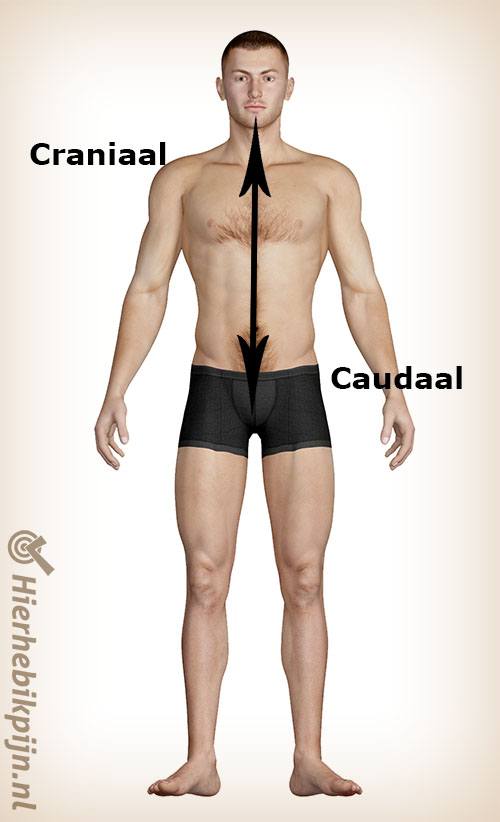
Humans have lost their tail in the course of evolution. "Caudal" therefore refers more to the tailbone. "Cranial" and "caudal" are mainly used to describe the trunk. For the arms and legs, the terms proximal and distal are used.
Example
The ribcage lies cranial to the hips, meaning the ribcage is closer to the head than the hips. The lower back, in turn, lies caudal to the neck.
These terms are mainly used by (para-)medical professionals, such as doctors and physiotherapists, to communicate more accurately about the location of an injury or problem. As a patient, you do not necessarily have to be familiar with these terms, but they can help you better understand a medical report.
Related topics
- Kinematic chain
- Muscle coordination
- Core stability (rompstabiliteit)
- Proximal and distal
- Cranial and caudal
- Conservative or operative
- Curative or palliative
- Progressive and regressive
- Akinesia
- Anterior and posterior
- Movements
- Lateral and medial
- Vein
- Ventral and dorsal
- Morbidity, multimorbidity and comorbidity
- Hypokinesia
- Bradykinesia