
- Assessment tools
- Goniometer
Goniometer
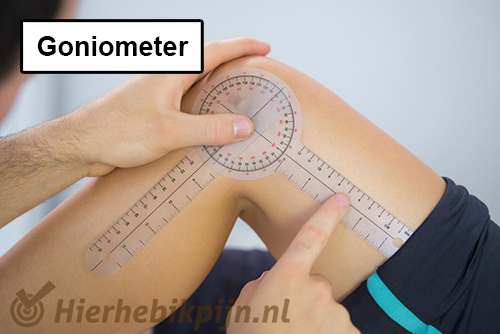
The goniometer or protractor is a assessment tool to measure the mobility (range of motion) of joints. The goniometer indicates with a number of degrees how far a joint can move. Nowadays there are also special apps and electronic/digital goniometers to measure the range of motion of joints.
The usefulness of measuring range of motion
By measuring joint mobility, the physiotherapist or doctor gains an impression of the severity of the condition or injury. This measurement is often performed at the first physical examination. For a good comparison, if possible, the healthy side is also measured. By repeating the measurement again at a later time, progress is monitored.
Is a joint becoming more mobile or not? In this way it is visible whether a treatment is effective and things are moving in the right direction, or whether the problem is actually getting worse.
What does a goniometer look like?
The goniometer has 2 arms and is made of transparent plastic. A 360-degree scale is marked on the instrument.
It works as follows: the point where the 2 plastic arms meet is placed at the level of the joint. The 2 arms each follow a body part. For example, in the case of the knee, 1 arm follows the thigh and the other the lower leg. At the moment of maximum flexion or (hyper)extension of the knee, the range of motion can be read from the number of degrees indicated by the goniometer.
Movements a goniometer measures
With a goniometer you can measure, for example, the following movements:
- Flexion and extension of the elbow or knee.
- Rotation of the hip or shoulder.
- Sideways movement of the wrist.
This can be done during both an active or passive movement of the joint. In an active movement the patient moves the joint under their own steam. In a passive movement the patient is as relaxed as possible while the physiotherapist or doctor moves the joint. Usually the range of motion is greater with a passive movement.
Reference values
For each joint and each movement, the average 'normal' range of motion has been described. If you are more mobile than normal, this is called hypermobility. If a joint moves less far than normal, this is called hypomobility.
Bear in mind that not everyone is the same, and one person is therefore more mobile than another. Characteristics that can cause differences in mobility include:
- Sex. Women are generally more mobile.
- Age. As you get older, mobility decreases. In (dementing) older people, paratonia is also seen. This is increasing muscle stiffness during movement.
- Weight or muscles. Someone with a lot of muscle or fat mass may, for example, be unable to bend an elbow as far because muscle or fat tissue limits the movement.
- Sport and exercise background. Someone who is not very active is often stiffer. Depending on the sport, some joints become more flexible and others less mobile.
- Diseases or injuries. There are numerous conditions in which the mobility of a joint decreases. Think of osteoarthritis, a poorly healed fracture, ankylosing spondylitis or swelling of a joint. But there are also diseases in which the joints have more freedom of movement, for example in a connective tissue disease.
- Predisposition or heredity. Members of the same family are sometimes more mobile or stiffer than others without there being an obvious explanation.
Neutral-0 method
To measure the range of motion of a joint, the Neutral-0 method (NNM) is used. A complete description of a movement consists of 3 numbers and whether the movement was performed actively or passively. Taking flexion (flexion) and extension (extension) of the knee joint as an example, the description is: flexion/extension, active 120-0-5. This means:
- The first number is the maximum flexion of the knee, 120 degrees.
- The 0 position is the neutral position of the joint. In the case of the knee this is extension, without any flexion or hyperextension of the knee joint. When a joint cannot fully extend, this number can therefore also be higher than 0.
- The last number is the hyperextension of the knee. In this case the knee can hyperextend by a maximum of 5 degrees.
Related topics