- Assessment tools
- Reflex hammer
Reflex hammer
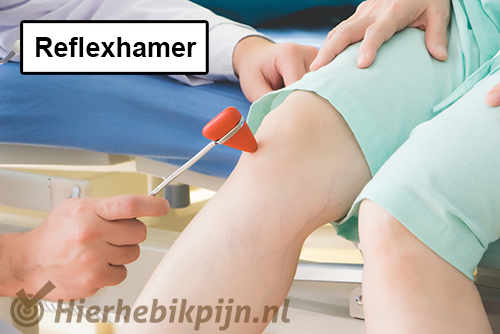
A reflex hammer is an instrument used to test muscle reactions. The instrument looks like a small hammer. Doctors and physiotherapists use this during the neurological examination to check the functioning of the nervous system. A well-known example is a tap of the hammer just under the kneecap, after which the leg extends by itself. That is called a reflex.
What does a reflex hammer look like?
There are different types of reflex hammer. Some have a crescent-shaped head, others are triangular or rounded. The head is usually made of rubber and is therefore soft, so the examination is not painful. Reflex hammers are quite heavy; this is needed to deliver a good tap.
What do you test with a reflex hammer?
With a reflex hammer, the doctor or physiotherapist measures the muscle stretch reflex, the spontaneous reaction of a muscle to a stimulus.
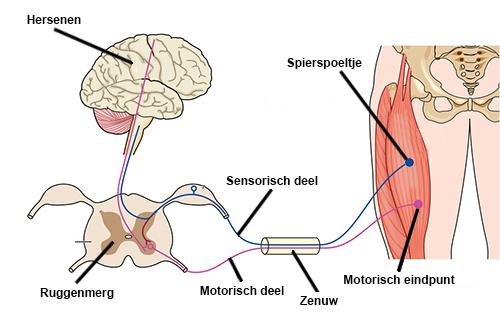
A tap on the tendon causes the muscle to stretch slightly for a short time. Within the muscle are the muscle spindles. These register the stretch of the muscle fibres and pass a signal along the nerve pathways that go to the spinal cord. This signal enters the spinal cord. If the signal is sufficiently strong, the muscle is instructed to contract and thus shorten. The body part then moves spontaneously.
For the best result, it is important that the patient adopts the correct posture and, is as relaxed as possible. The practitioner feels where the tendon is and then taps the tendon with the reflex hammer.
What does the result mean?
If a reflex is very weak, absent, or very strong, there may be a neurological problem. In reflex testing, it is important to look for the presence of certain patterns. For example, are the reflexes of both legs much stronger than those of the arms? Or does one side of the body react very differently from the other side?
When someone does not or hardly reacts to a reflex test, this is called hyporeflexia. There may be a problem in the nerves that emerge from the spinal cord (the peripheral nervous system). For example, in a hernia.
The opposite is hyperreflexia, a very strong reaction. This can be a sign of a disorder that affects the spinal cord or the brain (the central nervous system). This is the case, for example, with damage to the spinal cord due to a spinal cord injury, severe brain injury, or MS (multiple sclerosis).
In healthy people, clear reflex abnormalities do not occur often. Muscle stretch reflexes can differ enormously between people. One person hardly reacts to a tap of the hammer, while another has a very strong reaction.
This makes it difficult to determine whether there is an abnormality of the nervous system. That is why testing the muscle stretch reflexes is only part of the neurological examination. If a neurological problem is suspected, other tests must also be done to further investigate motor (movement) and/or sensory problems.
Related topics