
- Anatomy
- Hamstrings
Hamstrings
The hamstrings are a group of three muscles located at the back of the thigh. Their main function is to bend the knee and extend the hip.
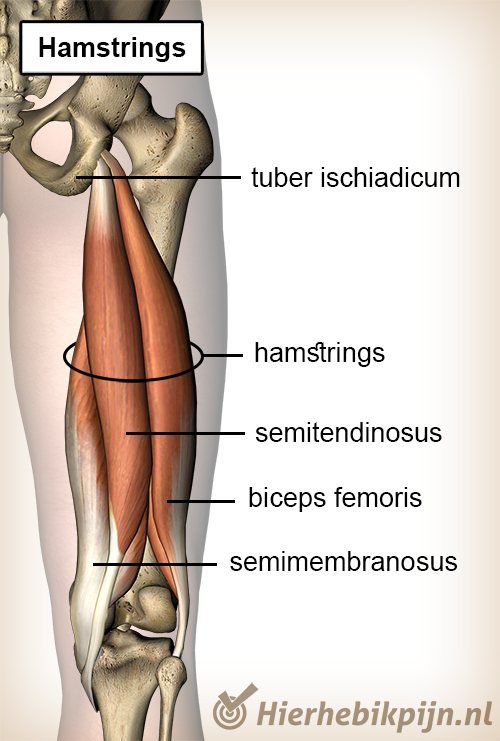
The hamstrings consist of a group of three muscles at the back of the thigh. Their main function is to bend the knee and extend the hip. The hamstrings are made up of:
- The long head of the musculus biceps femoris.
- The musculus semitendinosus.
- The musculus semimembranosus.
Similarities
These three muscles share several characteristics:
They are attached to the sitting bone of the pelvis (tuber ischiadicum), which is why an injury to the attachment or the upper half of the hamstrings can cause pain when sitting.
The muscles cross both the hip and the knee joint and are supplied by the same nerve. Because they act over two joints, the risk of injuries such as overuse or torn hamstrings is greater.
The hamstrings are active while walking, particularly to slow the forward swing of the leg. They also work when standing still to keep the body upright. Although the muscles can extend the hip and bend the knee, they cannot perform both actions simultaneously with maximal force.
The biceps femoris
The biceps femoris is a two-headed muscle with a long and a short head. Strictly speaking, the short head of the biceps femoris does not belong to the hamstrings; it is also supplied by a different nerve.
From the sitting bone, the long head of the biceps femoris runs to the outside of the knee and attaches to the fibula. Due to its location, this muscle can rotate the lower leg outward. Additionally, it protects the nervus ischiadicus, an important nerve that lies beneath the biceps femoris.
The semitendinosus and semimembranosus
The semitendinosus and semimembranosus follow the same path and end on the inside of the knee. This allows them to rotate the lower leg slightly inward.
The semitendinosus has a relatively long tendon and is much narrower than the semimembranosus.
Related topics
- Subscapularis
- Connective tissue
- Joint
- Ligaments
- Joint capsule
- Synovial fluid
- Bursa
- Nervous system
- Central nervous system
- Peripheral nervous system
- Motor nerve
- Sensory nerve
- Muscles
- Tendons
- Proprioception
- Dermatomes
- Hamstrings
- Achilles tendon
- Anatomy of the wrist
- Anatomy of the hand
- Osteoarthritis
- Anatomy of the foot
- Big toe
- Trigger points
- Anatomy of the thigh
- Cartilage
- Rotator cuff
- Intervertebral disc
- SI joint
- Lungs
- Anatomy of the abdominal muscles
- Anatomy of the bones
- Pelvic floor muscles
- Trapezius muscle
- Skin
- Anatomy of the spine